

To further enhance the overall quality of direct-to-garment (DTG) T-shirt printing and advance the in-depth development of DTG products.
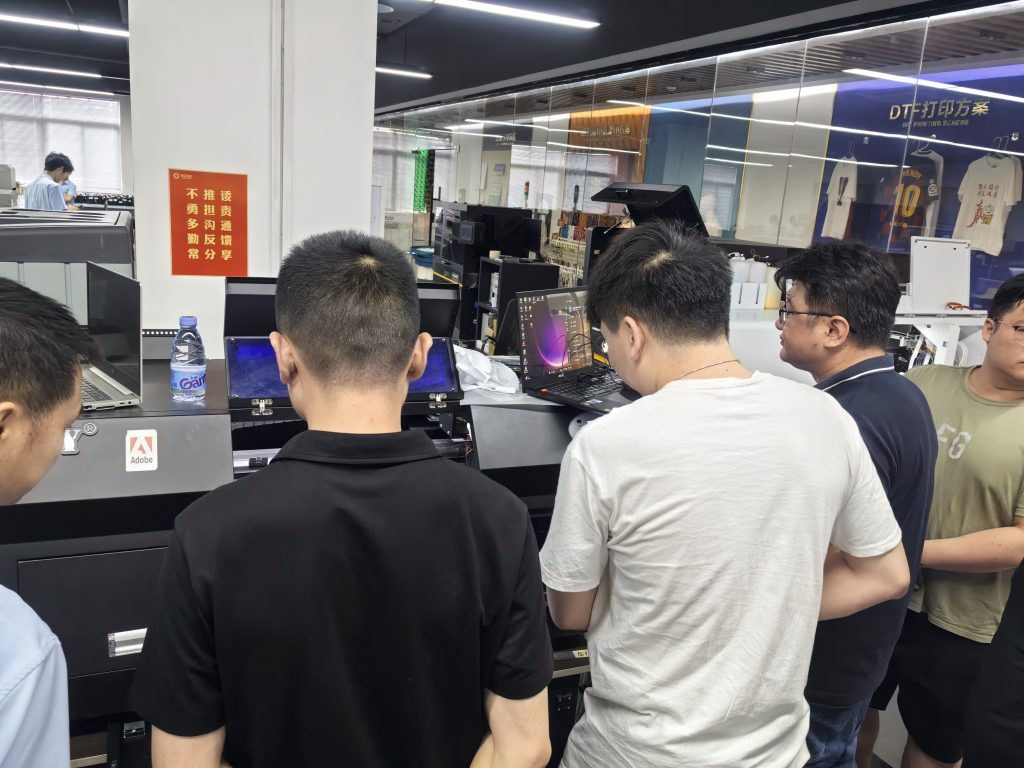
We recently held a dedicated technical seminar themed “System Optimization of the H·EASY DTG 4050 Printer in Terms of Fastness, Visual Harmony, and Cost Control.”
Led by the DTG product line, the seminar gathered key technical personnel from the R&D, process, production, after-sales service, and marketing departments.
They conducted in-depth discussions and technical verifications on the critical issues encountered in actual equipment usage.

Fastness Improvement: Systematic Optimization from Pretreatment to Fixation
The seminar began with a focus on one of the most pressing concerns for users—wash and rub fastness of printed T-shirt patterns.
By reviewing past customer feedback and laboratory test data. The R&D team conducted a detailed analysis of how different factors. Such as pretreatment liquid formulation, spray concentration, drying time, and environmental humidity directly affect print fastness.
Based on the characteristics of the H·EASY DTG 4050 printhead platform. Process engineers proposed optimizations to the pretreatment workflow, including the use of high-reactivity active pretreatment agents, improved spray techniques. And fine-tuned fixation temperature curves.
Comparative testing of multiple sample batches on-site showed a significant improvement in fastness with the optimized solution, reaching AATCC Grade 4.5 and above.
This indicates that under typical wear and wash conditions, the durability of printed patterns can be effectively extended.

Visual Harmony: Comprehensive Enhancement from Color Management to Image Reconstruction
In terms of image output quality, the seminar centered around how to make printed graphics appear more layered, natural, and visually harmonious.
The R&D team shared the newly developed ICC color curve system tailored to the H·EASY DTG 4050 printer.
This system supports personalized image preprocessing based on fabric type, background color, and pattern characteristics.
Moreover, a new image reconstruction algorithm was introduced to ensure smoother edge transitions and finer rendering in low-gray areas.
Real-world printing tests demonstrated that color block boundaries appeared softer, skin tones were more realistic, and overall visual cohesion was improved, greatly enhancing the visual appeal of finished T-shirts.
Cost Control: Accounting for Every Drop of Ink and Every Kilowatt
In today’s increasingly competitive market, cost control and profit maximization per unit have become core concerns.
During the seminar, our technical team conducted a comprehensive analysis from multiple dimensions. Including ink consumption management, energy efficiency in fixation, and print path optimization.
By adopting a new waveform control algorithm and adjustable droplet technology. The H·EASY DTG 4050 achieves reduced ink consumption while maintaining print accuracy.
In addition, we are testing a low-temperature fixation process for this model. Potentially reducing fixation temperatures from 160°C to below 130°C, yielding energy savings of over 20%.
On the software side, we proposed an AI-driven print path optimization solution. This algorithm automatically analyzes pattern distribution and reconstructs the print sequence and trajectory, minimizing unnecessary movement and repeated coverage.
This not only boosts operational efficiency but also further conserves consumables.

Looking Ahead: Customer-Centric Innovation, Continuous Product Advancement
This seminar not only provided a clear roadmap for the technical upgrade of the H·EASY DTG 4050. But also embodied our customer-oriented R&D philosophy.
Through cross-department collaboration and data sharing, we have shortened the gap between product development and actual customer needs.
Looking forward, we will use the outcomes of this seminar as a foundation to carry out phased testing and market follow-ups.
This will accelerate the transformation of R&D results into stable mass production capabilities, truly achieving the goals of “stronger fastness, better visuals, and lower costs.”
We are committed to providing our customers with more competitive DTG solutions.


