

In recent years, customized printed T-shirts have gradually become an important trend in the fashion industry. Particularly among younger consumers, individuality and uniqueness have become the primary considerations when purchasing clothing.
With continuous technological advancements, especially the rapid development of digital printing technologies. The production methods for customized printed T-shirts are undergoing significant changes.
This article will explore the production trends of customized printed T-shirts, analyze the industry’s development direction. And discuss how new technologies can improve production efficiency and quality to meet the growing personalized demands of consumers.
The Rise of Digital Printing Technology
In traditional T-shirt printing, common methods include screen printing, heat transfer printing, and sublimation printing. However, these methods have their limitations, such as the need for making templates in screen printing, which is suitable for mass production but not for small-batch customization. Heat transfer printing requires special transfer paper and has limited color saturation.
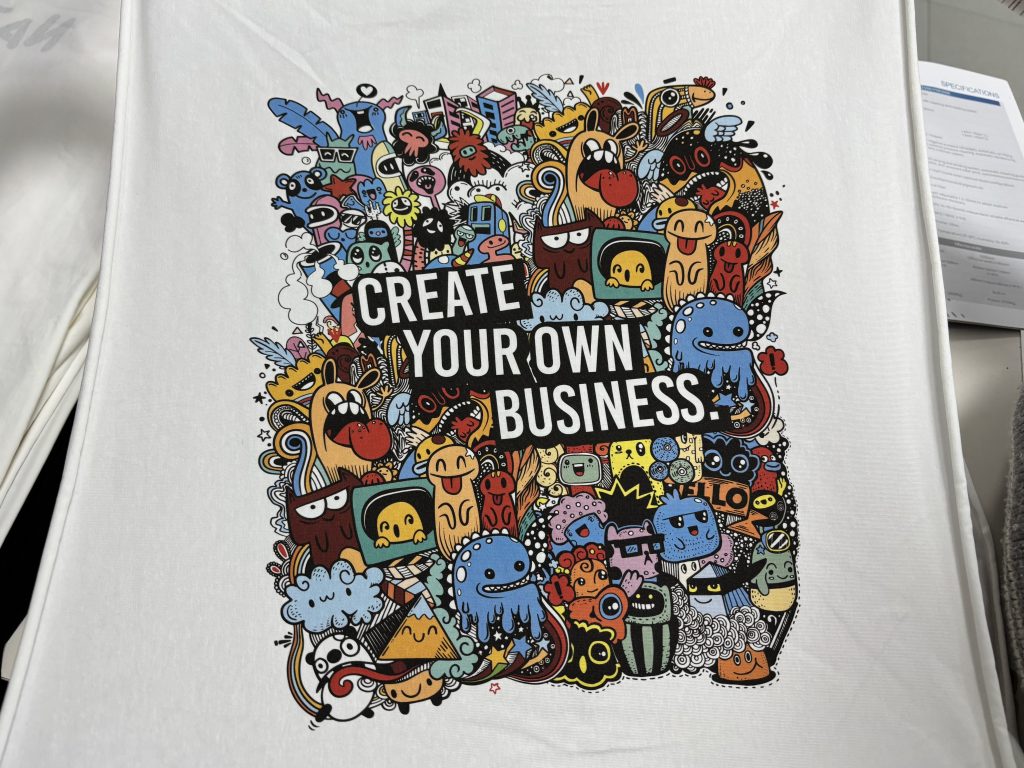
With the maturity of digital printing technologies, more and more custom T-shirt manufacturers are adopting digital printing technologies, especially UV inkjet printing, sublimation, and direct-to-garment (DTG) printing, which offer high production efficiency, clear image details, rich colors, and the ability to customize even single pieces.
1. Direct-to-Garment (DTG) Technology
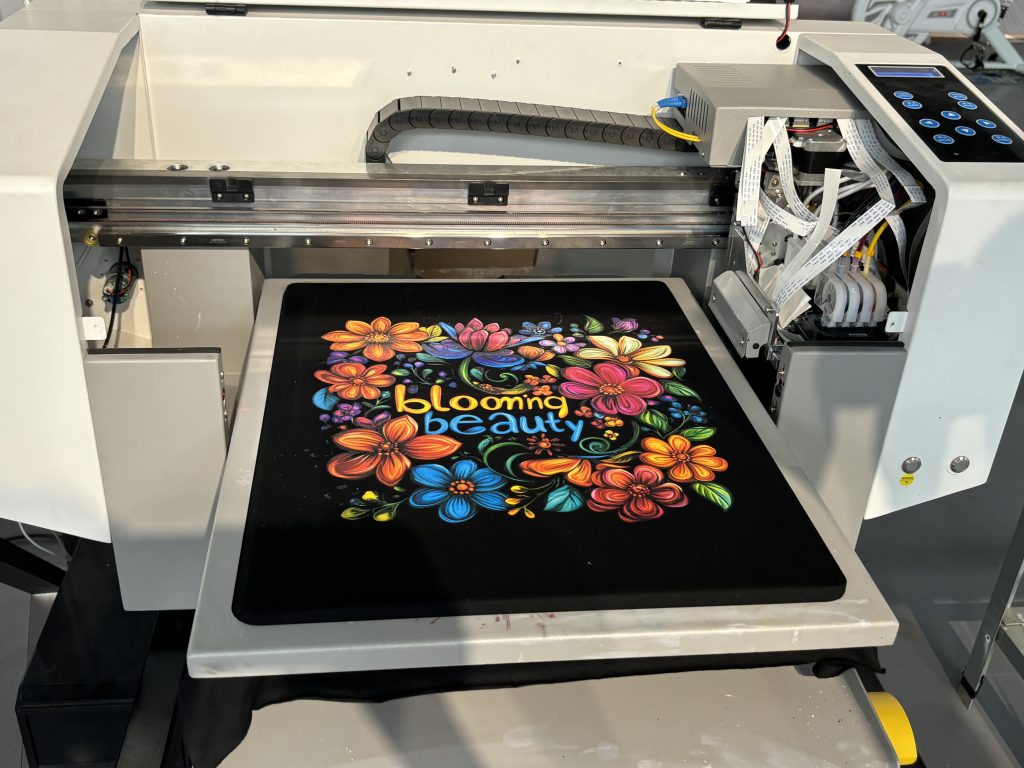
Direct-to-garment (DTG) printing is one of the most popular methods for T-shirt printing today. DTG printing uses specialized inkjet printers to print images directly onto the fabric of the T-shirt.
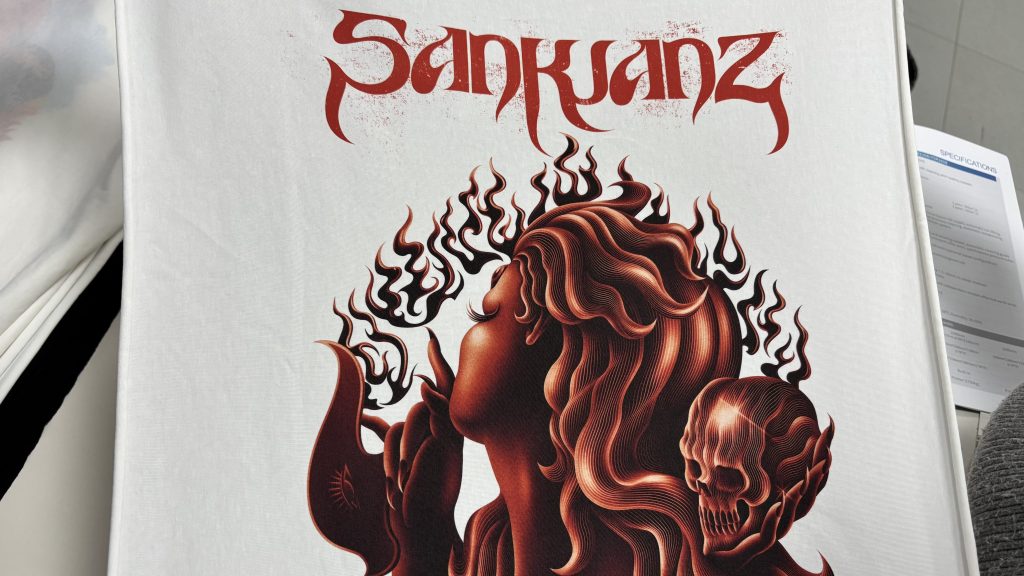
This method is characterized by high resolution, allowing for very detailed patterns with bright and durable colors. DTG printing is particularly suitable for small-batch production, especially for personalized customization.
An important advantage of DTG technology is its ability to print full-color patterns, even complex ones, with very clear detail.
This is a major advantage for today’s T-shirt market, driven by consumer demand for personalized and unique designs.
As consumer requirements for T-shirt designs become more demanding, DTG printing can effectively meet these needs, responding quickly to market changes and personalized consumer demands.
2. Heat Transfer Printing and Sublimation
Heat transfer printing is widely used in custom-printed T-shirts. It involves printing the design onto special transfer paper and then transferring the image onto the T-shirt fabric using a heat press machine.
Heat transfer printing is suitable for a variety of fabrics, but it may fall short in terms of color brightness and durability compared to DTG printing.
Sublimation printing is mainly used for polyester fibers and other synthetic fabrics. It uses the principle of heat sublimation to transfer the image onto the fabric, which results in bright colors and strong durability.
Sublimation printing is particularly suitable for large-scale production, especially in the customization of sportswear, workwear, and other large-volume custom garments.

The Trend of Personalization
As consumers’ demand for personalization and uniqueness continues to grow, customized printed T-shirts have become a representative of personalized fashion.
From design ideas and pattern choices to T-shirt styles and sizes, consumers want to customize every detail according to their preferences.
This demand for customization has driven a transformation in the industry, prompting companies to optimize production processes, enhance efficiency, and enable small-batch and multi-style production models.
1. The Rise of Online Customization Platforms
With the widespread use of the internet, more and more online customization platforms have emerged. Consumers can upload their design patterns, and choose styles, sizes, and other personalized preferences on these platforms, thus achieving the customization of T-shirts.
These platforms integrate design tools and production facilities, simplifying the customization process for consumers. Users only need to make a few simple steps to complete their customizations, and the production manufacturers will process the order accordingly.
These platforms not only provide design templates and editing tools but also allow users to freely design and create their patterns.
Through deep cooperation with printing factories, these platforms seamlessly link user designs with the production process, greatly improving customization efficiency.
2. Fast Response and Production
In the past, the production of custom T-shirts often required a long time, especially when a large number of custom designs needed to be produced. Production time and costs were often high.
However, with continuous advancements in production technologies, particularly digital printing, the production cycle for custom T-shirts has been significantly shortened.
By using DTG, heat transfer printing, and sublimation printing, manufacturers can quickly respond to orders and complete the design, printing, and delivery in a short time, ensuring timely fulfillment of custom orders.
Sustainability and Environmental Trends
As environmental awareness continues to grow, the production of customized printed T-shirts is increasingly focusing on sustainability and environmental friendliness.
From using eco-friendly water-based inks to adopting recyclable fabrics and reducing waste in the production process, more and more companies are emphasizing environmental responsibility in their production methods.
1. The Use of Eco-Friendly Inks
Traditional printing inks often contain harmful substances that can pose potential risks to the environment and human health. In contrast, eco-friendly water-based inks are non-toxic and harmless, and they offer bright colors and clear patterns.
With stricter environmental regulations, more and more T-shirt manufacturers are adopting water-based inks as the printing medium. This not only reduces environmental pollution but also improves consumer recognition of the brand.
2. The Application of Sustainable Fabrics
As consumers become more concerned about sustainability, the fabrics used in custom T-shirts are also shifting towards sustainable options.
Many custom-printed T-shirt manufacturers are starting to use organic cotton, recycled polyester, and other eco-friendly fabrics in their production. This not only meets environmental demands but also ensures the comfort and durability of the garments.
Moreover, with continuous technological innovations, some companies are exploring the use of 3D printing technology in T-shirt customization, making the production process more precise and environmentally friendly.
Intelligent and Automated Production
With the development of artificial intelligence (AI), the Internet of Things (IoT), and other technologies, the production of custom-printed T-shirts is gradually moving towards intelligent and automated production.
Companies are using intelligent production lines, automated equipment, and cloud computing technology to not only improve production efficiency and reduce manual intervention but also to accurately control every production step, ensuring the quality of every custom T-shirt.
1. Intelligent Production Lines
By introducing intelligent production lines, manufacturers can monitor and analyze every step of the production process in real-time.
For example, through intelligent control systems, they can adjust the working status of printing equipment to ensure the precision and quality of the printing.
Additionally, intelligent production lines are capable of flexibly adjusting production schedules in response to fluctuations in order volumes, improving production flexibility and responsiveness.
2. The Application of Automated Equipment
The use of automated equipment in T-shirt printing production has greatly increased efficiency. Automated printing machines can achieve continuous production without manual intervention, saving time and costs.
Intelligent management systems can also automatically adjust the equipment’s working conditions based on production demands, ensuring a high-efficiency production process.

Conclusion
The production trends of custom-printed T-shirts are undergoing profound changes, driven by technological innovations, evolving consumer demands, and increased environmental awareness.
Digital printing technologies, personalized customization platforms, the use of eco-friendly materials, and intelligent production trends are pushing the entire industry forward.
As consumers’ demands for individuality, environmental friendliness, and quality continue to grow, the production model for custom-printed T-shirts will continue to develop toward intelligence, personalization, and sustainability.
For manufacturers, the key to future competition will lie in technological innovation, improving production efficiency, and reducing costs, while ensuring product quality and sustainability.
Consumers will enjoy more personalized, customized, and eco-friendly clothing choices, and custom-printed T-shirts will undoubtedly play an increasingly important role in the fashion industry.


